.avif)
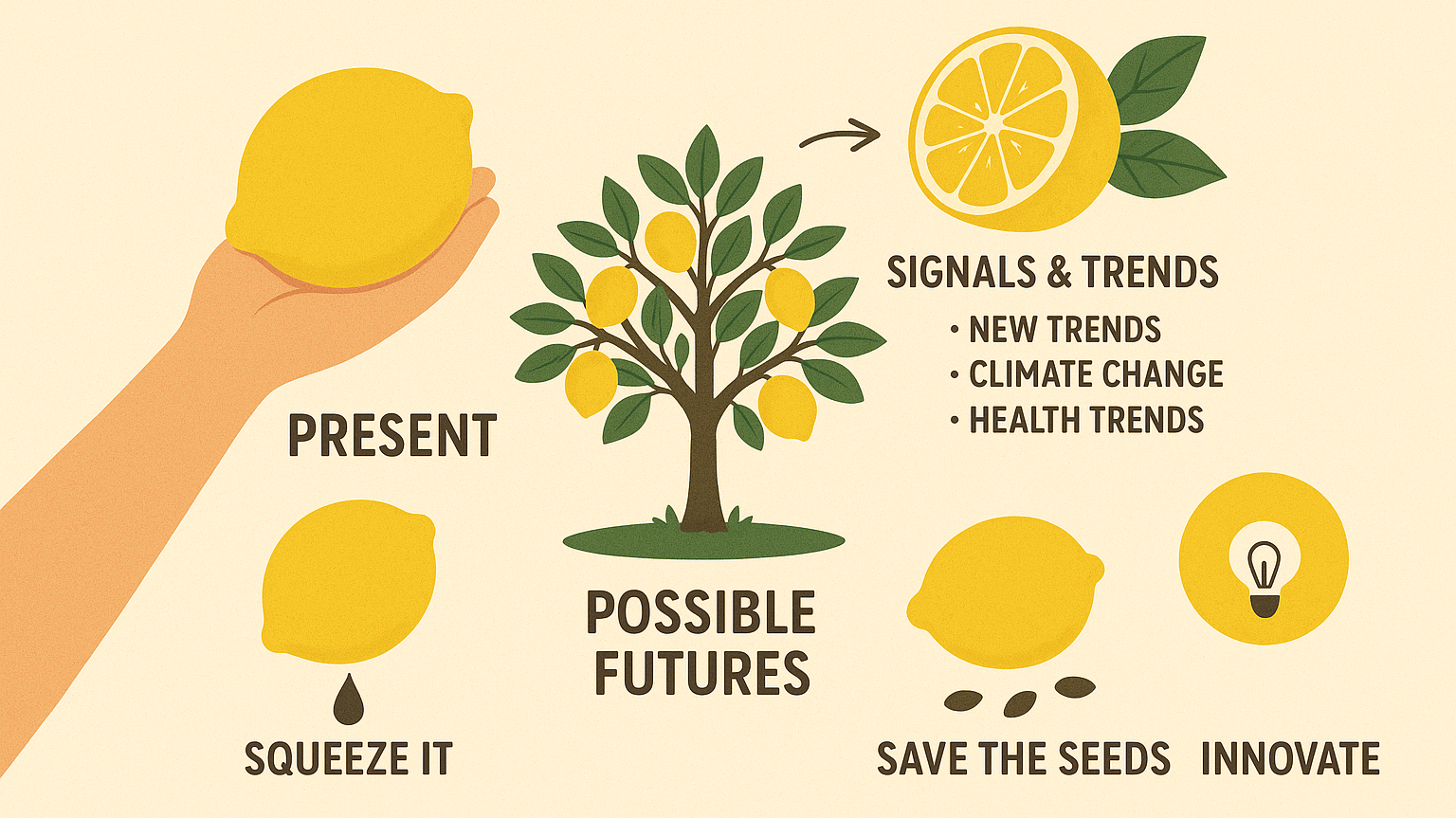
Strategy often feels like something for later, as the world around you changes rapidly. AI is redesigning sectors, market dynamics are shifting, customers are accelerating, and new players are claiming positions you're still unsure about. Change is not a question, but a certainty. The real challenge is: how do you stay agile as an organization and maintain your advantage? Futures thinking helps you look ahead and make better choices — quickly, focused, and confident about what's to come. No predictions, but direction.
Get ready for what counts tomorrow
Those who refrain from Futures Thinking are taking a big risk...
- Technological shifts wait for no one: AI, automation and data-driven models are rewriting the rules of the game. Waiting for it to be tangible means an inevitable backlog.
- New players play it differently and faster: Disruptive companies operate without the brakes of hierarchy or fear. They don't wait. They're building. Futures Thinking helps you stay ahead strategically.
- Customer expectations are constantly rising: What was innovative yesterday is standard today. Can your organization handle that speed?

Futures Thinking is not a crystal ball, but a strategic way of working.

Futures Thinking is not a crystal ball, but a strategic way of working. It helps organizations to recognize emerging trends and risks in a timely manner.
It enables you to spot growth opportunities early, accelerate innovation in a targeted manner and no longer respond reactively but proactively to changing market dynamics. By working with scenarios and forward-looking strategies, you make better-informed decisions. This is how you build a steadfast, agile organization.
Our approach: an iterative foresight process
At Lemon, we combine inspiring workshops with a structured foresight process. This process makes Futures Thinking a repeatable and flexible method, tailored to your business strategy.
→ Step 0: Introduction Workshops
We'll start with interactive sessions where your team learns the basics of Futures Thinking and foresight; topics such as horizon scanning, scenario planning and wind tunnelling lay a proactive foundation.
→ Step 1: Research & Horizon Scanning
We gather insights from various sources and carry out an extensive horizon scanning exercise. This helps identify early signals and emerging trends that form the basis for strategic scenarios.
→ Step 2: Scenario Mapping
We work with your team to develop multiple future scenarios. This stimulates strategic discussion and creativity, so that you are not predicting the future, but are prepared for it.
→ Step 3: Project Development & Wind Tunnelling
We test the impact of different strategies under various circumstances to find the most robust approach.
→ Step 4: Iterative Reflection & Continuous Process
Finally, we evaluate the results, refine scenarios and adjust priorities in a continuous feedback process. This process is repeated quarterly, so that your organization remains agile and always responds to new trends.
The biggest risk isn't change — it's failing to imagine futures differently.
Building together
Companies that integrate Futures Thinking are building:
- Strategic agility: no ad-hoc decisions, but substantiated choices based on scenarios.
- Innovative strength: anticipating what's coming and turning opportunities into new services and products.
- Competitive advantage: don't wait, but shape the future and stay one step ahead of the competition.
Curious? More information can be found on our Future Thinking webpage!
.svg)
.svg)