.avif)

Many organizations continue to frame digital decisions as a choice between "buy or build". This way of thinking is persistent, yet less applicable. Not because the question is unimportant, but because it is asked incorrectly. “Buy versus build” is not a technical contradiction, but a mental model that emerged at a time when software was either rented as a product or built entirely in-house.
Today, that picture is no longer true; buy versus build has become a false contradiction. Software landscapes are more complex, legacy is everywhere, and AI is emerging as a structural capacity rather than an experiment. The classic dichotomy masks more than it explains and leads to decisions that seem logical in the short term but create long-term limitations.
What 'buy' means in practice
In many organizations, “buy” has almost become synonymous with Software as a Service (SaaS). That's understandable: SaaS promises speed, predictability and a low entry threshold. This often works well for generic processes, but the problem occurs when it is interpreted too narrowly. “Buy” is automatically equated to rent, dependency, and limited control.
SaaS is therefore only one form of “buy”. You can also purchase software including source code, acquire a modular platform or take over an existing solution and further develop it. When 'buy' is reduced to SaaS, the debate narrows and options that are precisely interesting for organizations with complexity, legacy or AI ambitions disappear.
Moreover, SaaS is rarely designed as a structural carrier. Data is becoming fragmented, integrations remain fragile, and AI applications operate separately from the core landscape. What starts efficiently quickly turns into a patchwork.
'Build' as the holy grail?
At the other end of the spectrum is 'build', often seen as the ideal solution; complete customization that is perfectly tailored to your own needs and context. This picture is only true under strict conditions. “Build” works when software is part of the core product, when the organization has sufficient product maturity and when the expected lifetime of the solution justifies the investment.
In many other cases, 'build' is highly demanding. Zero-based development means that you are responsible for architecture, security, scalability, maintenance and continuous development. That costs time, money and also structural organizational attention. Especially for non-distinctive functionality, 'build' becomes an expensive detour.
Legacy exacerbates the problem. Most organizations do not start from a blank sheet, but from a historically grown IT landscape. Building completely from scratch then means migrating, decoupling and managing risks. That does not make 'build' impossible, but it does make it complex and often politically fraught.
It is important that 'build' is not a bad choice, but that it is often applied too broadly. Not everything that exists has to be reinvented.
The missing dimension: standard versus differentiation
The classic debate lacks a crucial second axis. In addition to the question “buy or build”? , there is the question whether you work with standard components or with differentiating customization. The two axes are intertwined and are often confused.
You can rent standard solutions or build custom solutions, but you can also opt for a standardized basis on which you add targeted customization. The latter option rarely gets a place in the debate, while in practice it is the most rational for many organizations.
In a context where AI is becoming increasingly important, this principle applies even more. AI initiatives often arise in a fragmented way. Without a clear shared medium, separate tools, scripts or subscriptions remain without coherence or cumulative effect.



From “buy versus build” to “buy & build”
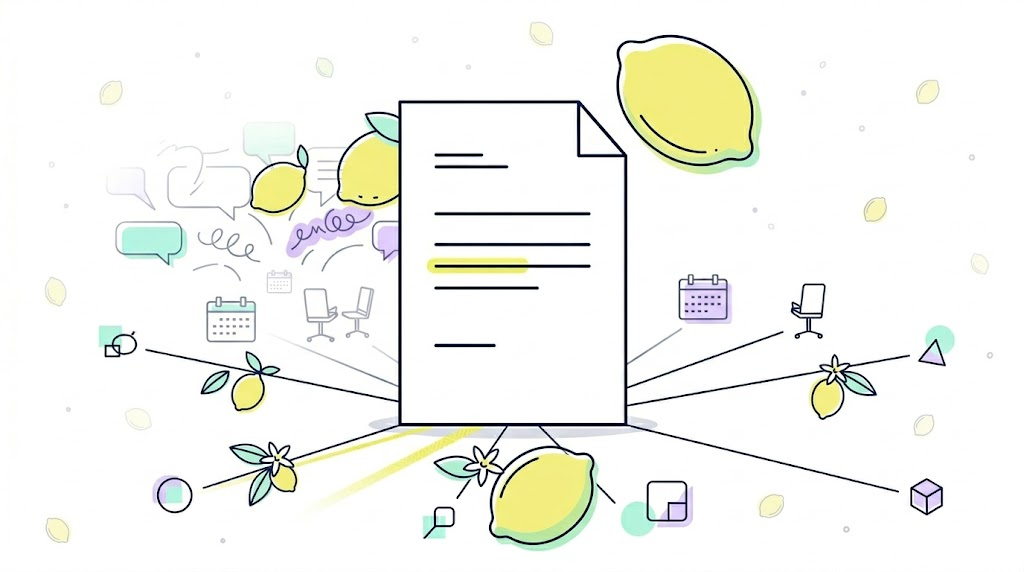
At Lemon, we don't start from the question of whether you should buy or build. We first look at your digital landscape; which part of your landscape may be standard and where does differentiation provide real added value. This is the core of our "buy & build" approach.
You start with a robust, proven foundation that covers all generic concerns. Architecture, security, integrations and scalability are already accounted for. This foundation forms the structural basis of your digital landscape, including legacy and future developments.
In addition, you build in a targeted manner with customization where it really makes a difference; on processes, workflows and logic that are specific to your organization. Customization is then not a comprehensive project, but a targeted extension.
AI requires a structural location
AI experiments are valuable for an organization, but rarely embedded in a sustainable way. AI is not an extra tool; it needs a place in your data, processes and governance.
The "buy & build" approach acts as an aggregator for AI initiatives; not by centralizing everything in one model, but by providing a cohesive carrier where AI applications land, are reused and can scale up safely. This is how you transform AI from a collection of separate tools into a strategic asset.
Ownership as a choice
The biggest difference with traditional SaaS lies in ownership. At Lemon, you not only buy functionality, but also the underlying code. Both the standardized foundation and the customization are yours.
This model gives you full control over data, AI applications, integrations and future choices. You avoid vendor lock-in and build software as a valuable asset, not as a temporary service. In a world of legacy, strict regulations and rapid technological evolution, this is not a detail, but a strategic precondition.
No compromise, but redefinition
So "buy & build" is not a middle ground between two extremes. It is a redefinition of the issue. You don't have to choose between speed and best fit, you can consciously combine them. By looking differently, you are not experimenting without ownership, but you build structural digital assets with a cumulative effect with space for legacy, differentiation and AI.


.webp)